Year 8, we are almost done with the school year. Wednesday is our final Activity Day and I'm sure we will all have fun at the beach and Friday is only a half day but before we go we still have a few classes so let's make the best of our time.
Today I'd like to acquaint you with BBC Kids and their wonderful website.
http://www.bbc.co.uk/schools/games/
Learning Objective - The student will: learn about what a great resource BBC Kids is and have fun playing educational games.
Sunday, June 26, 2011
Sunday, June 19, 2011
June 20, 22
June 13, 15, 16
Continue with the Create. When you are finished, write a paragraph reflecting on the creation process.
Then move on to EVALUATE - Criterion E, maximum 6
1. Print the questionnaire (that you created in the Investigate) and show your CAD building to 5 people and ask them to answer your questionnaire.
2. Write a paragraph to "analyze" the feedback. In other words write about the scores that you received and say how your CAD building could be improved based on the feedback.
3. Evaluate your performance at each stage of the design cycle: Investigate, Design, Plan, Create AND suggest ways that you can improve your performance. (You need 4 paragraphs here).
4.Write a final paragraph saying if you accomplished your goal and what impact it will have. In other words, look at the unit question - were you successful? Explain. Remember we were successful. Each of you has built a building that will positively contribute to our "perfect" community.
Learning objectives - The student will: carry out tests to compare final product against design specification, suggest improvements, reflect on their performance and identify parts they found difficult and suggest ways in which their performance could be improved, consider the impact of the product/solution on individuals and/or society, and explain how the product/solution could be improved.
Then move on to EVALUATE - Criterion E, maximum 6
1. Print the questionnaire (that you created in the Investigate) and show your CAD building to 5 people and ask them to answer your questionnaire.
2. Write a paragraph to "analyze" the feedback. In other words write about the scores that you received and say how your CAD building could be improved based on the feedback.
3. Evaluate your performance at each stage of the design cycle: Investigate, Design, Plan, Create AND suggest ways that you can improve your performance. (You need 4 paragraphs here).
4.Write a final paragraph saying if you accomplished your goal and what impact it will have. In other words, look at the unit question - were you successful? Explain. Remember we were successful. Each of you has built a building that will positively contribute to our "perfect" community.
Learning objectives - The student will: carry out tests to compare final product against design specification, suggest improvements, reflect on their performance and identify parts they found difficult and suggest ways in which their performance could be improved, consider the impact of the product/solution on individuals and/or society, and explain how the product/solution could be improved.
Sunday, June 5, 2011
June 6, 8, 9
Then move on to EVALUATE - Criterion E, maximum 6
1. Print the questionnaire (that you created in the Investigate) and show your CAD building to 5 people and ask them to answer your questionnaire.
2. Write a paragraph to "analyze" the feedback. In other words write about the scores that you received and say how your CAD building could be improved based on the feedback.
3. Evaluate your performance at each stage of the design cycle: Investigate, Design, Plan, Create AND suggest ways that you can improve your performance. (You need 4 paragraphs here).
4.Write a final paragraph saying if you accomplished your goal and what impact it will have. In other words, look at the unit question - were you successful? Explain. Remember we were successful. Each of you has built a building that will positively contribute to our "perfect" community.
Learning objectives - The student will: carry out tests to compare final product against design specification, suggest improvements, reflect on their performance and identify parts they found difficult and suggest ways in which their performance could be improved, consider the impact of the product/solution on individuals and/or society, and explain how the product/solution could be improved.
Saturday, May 28, 2011
May 30, June 1, June 2
Year 8 - When you finish with your Design, let's move to Create - Criterion D (maximum 6 points)
2 Tasks:
- Create your building
- Write a reflection on the creation process. Did you make any modifications or changes to your original design?
Sunday, May 22, 2011
May 23, 25
Year 8, on second thought you NEED a design. Why? It will help you define what you want to create before you begin creating. It will help you stay more focused and keep to your design specification.
Learning objectives - The student will: generate 3 designs that attempt to meet the design specification;, compare the designs against the design specifications and identify the pros and cons of each design; select one design and explain its choice.
Thursday, May 19, 2011
May 19 - It's Quiz Time
Before you begin, please take a few minutes to complete the following quiz on the MYP Design Cycle:
http://www.quia.com/quiz/2950603.html
This mini-Design Cycle quiz will register all of your answers. It's fun! Give it a try!
Now, let's finish our Investigations today and submit them before you leave;-)
Learning objective - The student will: consider the importance of the problem for life, society and/or the environment; collect and select information, organize it logically and, with guidance, begin to analyse it; list, with guidance, the specific requirements that must be met by the product/solution, design, with guidance, tests to evaluate the product/solution against the design specification.
Wednesday, May 18, 2011
May 16, 18, 19
Year 8, we are back in business!
Before we begin, please check the computer you are sitting at to make sure that Google SketchUp 8 is installed;-)
Now, let's see where we are:
INVESTIGATE - Criterion A:
1)Identify the Problem (write 2 paragraphs; 1 introduction, 1 connecting to AOI)
2)Develop a Design Brief (ask and answer questions to help you solve the problem, collect info, complete tutorial)
3) Formulate a Design Specification (detailed list of characteristics that product must be/adhere to; create test to evaluate product)
Monday, May 9, 2011
May 9
Whether you like Coca Cola or not, you have to applaud their 125th anniversary.
Develop a Design Brief: Answer the following questions. Write in complete sentences. Use in-text referencing.
1.What is Google Sketchup7?
2.What does CAD stand for?
3.What can a CAD program do? Explain and include details.
4.Which professions use CAD programs? (Name at least 3)
5.Decide which building you will contribute, and then research this type of building.
6.Include images of at least 3 different buildings and evaluate each to gather ideas and
information.
7.What is Google Sketchup’s 3-D Warehouse? Explain in your own words and include details.
8.How can you use this tool to help you? Explain in your own words and include details.
When you have finished answering these questions, please start working on the "New to Google Sketchup" tutorials to learn how the programme works. http://sketchup.google.com/intl/en/training/videos.html
Learning Objective - The student will: ask relevant questions at the different stages of the investigation; identify appropriate sources of information and acknowledge these using a recognized convention; consider, with guidance, the value of sources of information.
Tuesday, April 26, 2011
May 2, 4, 5
Year 8 - Term 3 has already started so let's get down to business;-)
Today we will look at the Unit of Work and the Assessment Rubric and then begin our Investigation.
Remember that there are 3 separate tasks in the Investigate stage of the Design Cycle: Identify the problem, Develop a design brief, Formulate a design specification.
Today during class we will complete 1: Identify the problem
To ensure success follow this template. . .
1 sentence - State the problem that you are going to solve. *
1 sentence - Restate (say again in your own words) the problem (from Unit of Work)
2-3 sentences - Say why you think this project is relevant (why are we building the perfect city using Google SketchUp?)
1-2 Sentences – Say how you will solve the problem
1-2 sentences – Say how Human Ingenuity connects to your project
*Example: The problem I am going to solve in IT class this term is, “How can Google SketchUp help me contribute to my community?"
Sunday, April 10, 2011
April 11, 13
Year 8 - I would like you to know just how important a production plan is. Sooooo, we are going to conduct a little experiment. Each of you will use a plan to create a classmate's tri-fold pamphlet.
Then, we will get together to see if the plan worked exactly and to compare the pamphlets with one another.
This is going to be so much fun. Let's go!
Learning objective: The student will learn that production plans are valuable tools.
Then, we will get together to see if the plan worked exactly and to compare the pamphlets with one another.
This is going to be so much fun. Let's go!
Learning objective: The student will learn that production plans are valuable tools.
Tuesday, April 5, 2011
April 4, 6
| http://leiden.toastmasters.nl/files/2011/03/evaluate-adjust1.jpg |
2. Write a paragraph to "analyze" the feedback. In other words write about the scores that you received and say how your tri-fold pamphlet could be improved.
3. Evaluate your performance at each stage of the design cycle: Investigate, Design, Plan, Create AND suggest ways that you can improve your performance. (You need 4 paragraphs here).
4. Write a final paragraph saying if you accomplished your goal and what impact it will have. In other words, look at the unit question - were you successful? Explain.
Learning objectives: carry out tests to compare final product against design specification, suggest improvements, reflect on their performance and identify parts they found difficult and suggest ways in which their performance could be improved.
Saturday, March 26, 2011
March 28, 30
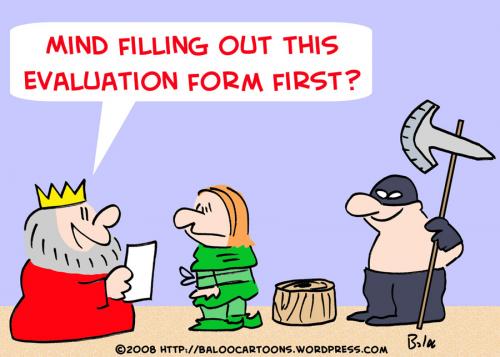
| http://fr.toonpool.com/user/997/files/king_executioner_evaluation_form_248675.jpg |
Year 8 - Let's continue on with the Evaluate. It is due no later than end of class on March 30;-)
1. Print the questionnaire (that you created in the Investigate) and show your tri-fold pamphlet to 5 people and ask them to answer your questionnaire.
2. Write a paragraph to "analyze" the feedback. In other words write about the scores that you received and say how your tri-fold pamphlet could be improved.
3. Evaluate your performance at each stage of the design cycle: Investigate, Design, Plan, Create AND suggest ways that you can improve your performance. (You need 4 paragraphs here).
4. Write a final paragraph saying if you accomplished your goal and what impact it will have. In other words, look at the unit question - were you successful? Explain.
Learning objectives: carry out tests to compare final product against design specification, suggest improvements, reflect on their performance and identify parts they found difficult and suggest ways in which their performance could be improved
2. Write a paragraph to "analyze" the feedback. In other words write about the scores that you received and say how your tri-fold pamphlet could be improved.
3. Evaluate your performance at each stage of the design cycle: Investigate, Design, Plan, Create AND suggest ways that you can improve your performance. (You need 4 paragraphs here).
4. Write a final paragraph saying if you accomplished your goal and what impact it will have. In other words, look at the unit question - were you successful? Explain.
Learning objectives: carry out tests to compare final product against design specification, suggest improvements, reflect on their performance and identify parts they found difficult and suggest ways in which their performance could be improved
Sunday, March 20, 2011
March 21, 23, 24
| http://titanrealestatesolutionllc.com/images/evaluate.jpg |
2. Write a paragraph to "analyze" the feedback. In other words write about the scores that you received and say how your tri-fold pamphlet could be improved.
3. Evaluate your performance at each stage of the design cycle: Investigate, Design, Plan, Create AND suggest ways that you can improve your performance. (You need 4 paragraphs here).
4. Write a final paragraph saying if you accomplished your goal and what impact it will have. In other words, look at the unit question - were you successful? Explain.
Learning objectives: carry out tests to compare final product against design specification, suggest improvements, reflect on their performance and identify parts they found difficult and suggest ways in which their performance could be improved
Tuesday, March 15, 2011
March 16
Year 8 -
Please finish your Create. Submit your pamphlet and the paragraph evaluating your plan;-)
Then, let's move on to EVALUATE - Criterion E (maximum 6)
1.Students are expected to evaluate the product/solution against the design specification in an objective manner based on testing, and to evaluate its impact on life, society and/or the environment. They are expected to explain how the product/solution could be improved as a result of these evaluations.
2.Students are expected to evaluate their own performance at each stage of the design cycle and to suggest ways in which their performance could be improved.
To get a 6 the student: evaluates the success of the product/solution considering the results of testing, and the views of the user. The student evaluates their own performance at some stages of the design cycle and considers improvements. The student considers the impact of the product/solution on life, society and/or the environment.
1. Print the questionnaire (that you created in the Investigate) and show your tri-fold pamphlet to 5 people and ask them to answer your questionnaire.
Learning objectives - The student will: carry out tests to compare final product against design specification.
Saturday, March 12, 2011
March 14
| http://www.funkymoose.co.uk/images/bright%20eyed.jpg |
We have a double so let's finish our pamphlets today!!!
Now, use your plan to create your tri-fold pamphlet.
3Tasks
1. Follow your plan,
2. Create your tri-fold pamphlet,
3. Write a paragraph to say if your plan worked and write about any changes you made to your design.
Learning Objectives for Create: The student will: use appropraite techniques and equipment competently; follow the plan to produce the product/solution with minimal guidance; review the plan and explain any changes to the plan (when necessary); create a product/solution of appropriate quality.
Monday, February 28, 2011
March 2, 3
| http://www.ps3vault.com/wp-content/uploads/2009/12/1059891342_f9a079fa99.jpg |
Now, use your plan to create your tri-fold pamphlet.
3Tasks
1. Follow your plan,
2. Create your tri-fold pamphlet,
3. Write a paragraph to say if your plan worked and write about any changes you made to your design.
Learning Objectives for Create: The student will: use appropriate techniques and equipment competently; follow the plan to produce the product/solution with minimal guidance; review the plan and explain any changes to the plan (when necessary); create a product/solution of appropriate quality.
Friday, February 18, 2011
February 21, 23, 28
| http://livingtrustnetwork.com/images/stories/plan-in-action.jpg |
Then, let's move onto Criterion C - PLAN - Maximum 6
In this section: Students are expected to construct a plan to create their chosen product/solution that has a series of logical steps, and that makes effective use of resources and time.
Students are expected to evaluate the plan and justify any modifications to the design.To get a 5/6:
- The student produces a plan that contains a number of logical steps that include resources and time.
- The student evaluates the plan and attempts to justify any modifications to the design.
3 Tasks
1 - Make a list of the resources we will use.
2 - Make a table with the steps needed to create our digital story - Include the time it will take for each step.
3 - Write a paragraph evaluating the plan (saying why it will work- Remember that you plan will work because: 1) you have lots of practice with Publisher 2010, 2) you had Publisher open when you were creating your plan.;-).
Learning Objectives for Plan: The student will: devise, with guidance, a series of logical steps to create the product/solution; construct a plan to create the product/solution that makes effective ue of resources and time; analyze the plan and explain the need for any modifications to the plan.
1 - Make a list of the resources we will use.
2 - Make a table with the steps needed to create our digital story - Include the time it will take for each step.
3 - Write a paragraph evaluating the plan (saying why it will work- Remember that you plan will work because: 1) you have lots of practice with Publisher 2010, 2) you had Publisher open when you were creating your plan.;-).
Thursday, February 17, 2011
February 17
| http://www.techpin.com/wp-content/uploads/2010/01/cool-website-design.jpg |
Year 8, You are working very hard this week. Well done!
Today we will finish the 3rd Tri-Fold Pamphlet design. Afterwards, you will document your learning. Look at the Design Template tab on this blog.
Learning objectives - The student will: generate 3 designs that attempt to meet the design specification;, compare the designs against the design specifications and identify the pros and cons of each design; select one design and explain its choice.
Sunday, February 13, 2011
February 14, February 16
Design - Criterion B - Maximum 6 points
Now you have loads of information about what Publisher 2010 can do! So let's take this project one step further.
First, we will look at Microsoft Publisher 2010 tri-fold pamphlets to get instructions that will help us organize our information on our tri-fold pamphlets;
Then, we will each get 3 sheets of paper, fold them into thirds and we will design 3 different possible tri-fold pamphlets. Let's go Year 8!!!
Learning Objective: The student will be able to: generate several feasible designs that meet the design specification.
Sunday, February 6, 2011
February 7, 9
Good morning Year 8.
Please print your Investigations and hand them in.
Today we are going to explore Publisher 2010.
1. Let's take a look around Microsoft Publisher 2010 - a view from the outside: http://desktoppub.about.com/od/microsoft/ig/Microsoft-Publisher-2010/Word---Publisher-2010.htm
2. Next, open Publisher 2010 and scan Publication Types and then Brochures. Click on one to open it and let's discuss the information that is on the template.
3. Now let's look at Microsoft Publisher 2010 - a view from the inside:
http://office.microsoft.com/en-us/publisher-help/basic-tasks-in-publisher-2010-HA101830007.aspx
4. Now it's your turn - Have fun!
Sunday, January 30, 2011
January 31, February 2
Year 8 - Now it's your turn to 3. Formulate a Design Specification
A Design Specification is a statement (list) that tells the designer exactly what the product has to do and what the design requirements are.
What kinds of Design Specifications are appropriate for a written document?
1. Let's brainstorm and you will complete your list.
2. Now, create test to evaluate your product. Remember to include a rating scale (on a scale of 1 to 10. 1=legendary, 10=lame) please answer the following questions.
Learning Objective - The Student will: understand the concept and importance of the design specification, and understand the importance of testing to determine the success of the product/solution and, with guidance, design a simple test.
Saturday, January 22, 2011
January 24, 26
Great! Year 8 - we are now onto the 2nd stage of the Investigate:
2. Develop a Design Brief
This is the section that we ask questions that will help "drive" the investigation. That is, we will create questions that you can research and the answers will give you enough information to help you solve your problem.
Aspects that we want to take into consideration are:
1). gather information on Child Labour to include in your pamphlet
- you might want to select information on several examples/countries
2). gather images for support
3). how can people help? gather information and links on organizations that help
4). research Microsoft Publisher 2010
Let's brainstorm some questions that will help you with your research;-)
THE RESEARCH QUESTIONS ARE AS FOLLOWS:
1) What information on Child Labour can I include in my tri-fold pamphlet?
2) What images are related to Child Labour and can support my information?
3) How can people help? What information and links on organizations can I find to include in my tri-fold pamphlet?
Note: please remember to include the URL's you visit;-)
Learning Objective - The student will: ask relevant questions at the different stages of the investigation; identify appropriate sources of information and acknowledge these using a recognized convention; consider, with guidance, the value of sources of information.
Sunday, January 16, 2011
January 17, 19
Year 8, First let's take a look at the handout to learn a little about the problem of child labour. (This should take 1 period).
Next, let's begin the first stage of the Investigation - 1. Identify the Problem. This is the introduction to your project. This paragraph lets the reader know what the problem is, how you are going to solve it, who your intended audience is and how it connects to "Health and Social Education". If you have any questions about how to construct your paragraph you have loads of options: 1) Look at the work you did in Term 1 and use it as a guide, 2) access the Investigate Template tab at the top of this blog, 3) ask the teacher for feedback on what you have written ;-)
Learning objective - The student will: outline a simple design brief; consider the importance of the problem for life, society and/or the environment.
Next, let's begin the first stage of the Investigation - 1. Identify the Problem. This is the introduction to your project. This paragraph lets the reader know what the problem is, how you are going to solve it, who your intended audience is and how it connects to "Health and Social Education". If you have any questions about how to construct your paragraph you have loads of options: 1) Look at the work you did in Term 1 and use it as a guide, 2) access the Investigate Template tab at the top of this blog, 3) ask the teacher for feedback on what you have written ;-)
Learning objective - The student will: outline a simple design brief; consider the importance of the problem for life, society and/or the environment.
Tuesday, January 11, 2011
January 12
Our unit question is: "How hard should children work?"
Let's take a minute and look at the Unit of Work.
Now let's explore just why this is such an important issue: Nike and Child Labor
Unicef - http://www.unicef.org/protection/index_childlabour.html
Save the Children - http://www.savethechildren.in/?pinid=97182244&gclid=COjh5p6Rs6YCFRgz3godmzH9oQ
Anti-Slavery Society - http://www.anti-slaverysociety.addr.com/toc.htm
Our task is to create a pamphlet using Publisher 2010 to raise awareness of this issue and promote change.
Sunday, January 2, 2011
January 3, 5, 6 - 2011
Welcome back Year 8. I hope you had a wonderful holiday break and are rested and ready to get down to work in 2011!
EVALUATE - Criterion E Maximum 6
1.Students are expected to evaluate the product/solution against the design specification in an objective manner based on testing, and to evaluate its impact on life, society and/or the environment. They are expected to explain how the product/solution could be improved as a result of these evaluations.
2.Students are expected to evaluate their own performance at each stage of the design cycle and to suggest ways in which their performance could be improved.
To get a 6 the student: evaluates the success opf the product/solution considering the results of testing, and the views of the user. The student evaluates their own performance at some stages of the design cycle and considers improvements. The student considers the impact of the product/solution on life, society and/or the environment.
1. Print the questionnaire (that you created in the Investigate) and show your digital story to 5 people and ask them to answer your questionnaire.
2. Write a paragraph to "analyze" the feedback. In other words write about the scores that you received and say how your digital story could be improved.
3. Evaluate your performance at each stage of the design cycle: Investigate, Design, Plan, Create AND suggest ways that you can improve your performance. (You need 4 paragraphs here).
4. Write a final paragraph saying if you accomplished your goal and what impact it will have. In other words, look at the unit question - were you successful? Explain.
Learning objectives: carry out tests to compare final product against design specification, suggest improvements, reflect on their performance and identify parts they found difficult and suggest ways in which their performance could be improved.
Friday, December 31, 2010
Tuesday, December 14, 2010
December 15
Year 8 - You deserve some down time.
Then,
1.Let's make snowflakes online. You can print them too http://snowflake.bhg.com/
2. Decorate a virtual Christmas cookie. You can share them with your friends;-) http://www.bhg.com/holidays/create-a-cookie/
Learning Objective: The student will HAVE FUN!
Monday, December 13, 2010
December 13
Year 8
Today I would like you to make sure you submit (or have submitted) Investigate, Design, Plan, and Create.
Let's go!!!
Today I would like you to make sure you submit (or have submitted) Investigate, Design, Plan, and Create.
Let's go!!!
Sunday, December 5, 2010
December 6, 9
Year 8 - Unfortunately we only have 2 lessons this week again so we have to stay focused and work hard;-)
The tasks for today and Thursday
1. Finish your photostory, save it 2 ways (as a movie, as a project),
2. Write a paragraph to say if your plan worked and write about any changes you made to your design,
3. Print the questionnaire (that you created in the Investigate) and show your digital story to 5 people and ask them to answer your questionnaire.
4. Write a paragraph to "analyze" the feedback. In other words write about the scores that you received and say how your digital story could be improved.
EVALUATE - Let's look at the assessment rubric: http://www.box.net/shared/9egggey35v
Learning Objectives:
CREATE - The student will: use appropraite techniques and equipment competently; follow the plan to produce the product/solution with minimal guidance; review the plan and explain any changes to the plan (when necessary); create a product/solution of appropriate quality.
EVALUATE - The student will: carry out tests to compare the product/solution against the design specification; consider the success of the product/solution in an objective manner based on testing, their own views and the views of the intended user; explain how the product/solution could be improved.
The tasks for today and Thursday
1. Finish your photostory, save it 2 ways (as a movie, as a project),
2. Write a paragraph to say if your plan worked and write about any changes you made to your design,
3. Print the questionnaire (that you created in the Investigate) and show your digital story to 5 people and ask them to answer your questionnaire.
4. Write a paragraph to "analyze" the feedback. In other words write about the scores that you received and say how your digital story could be improved.
EVALUATE - Let's look at the assessment rubric: http://www.box.net/shared/9egggey35v
Learning Objectives:
CREATE - The student will: use appropraite techniques and equipment competently; follow the plan to produce the product/solution with minimal guidance; review the plan and explain any changes to the plan (when necessary); create a product/solution of appropriate quality.
EVALUATE - The student will: carry out tests to compare the product/solution against the design specification; consider the success of the product/solution in an objective manner based on testing, their own views and the views of the intended user; explain how the product/solution could be improved.
Sunday, November 28, 2010
November 29 - December 1 - Holiday)
Good Morning Year 8. I'm a bit under the weather today and have a touch of laryngitis. Don't worry, it's not contagious!!!
We only have 2 lessons this week because Wednesday is a holiday;-) So today I would like you to work really hard and try to finish creating your digital story.
Remember that you can come in during break and lunch time for a few minutes to work on your project.
Learning Objectives: The student will: use appropraite techniques and equipment competently; follow the plan to produce the product/solution with minimal guidance; review the plan and explain any changes to the plan (when necessary); create a product/solution of appropriate quality.
We only have 2 lessons this week because Wednesday is a holiday;-) So today I would like you to work really hard and try to finish creating your digital story.
Remember that you can come in during break and lunch time for a few minutes to work on your project.
Learning Objectives: The student will: use appropraite techniques and equipment competently; follow the plan to produce the product/solution with minimal guidance; review the plan and explain any changes to the plan (when necessary); create a product/solution of appropriate quality.
Sunday, November 21, 2010
November 22, 24, 25
PLAN (Criterion C) and CREATE (Criterion D)
PLAN - Criterion C Maximum 6
Let's look at the assessment rubric: http://docs.google.com/Doc?docid=0AZHvRJKjycg1ZGdnNHBieDhfMzZncGoydm5jbg&hl=en
Learning Objectives for Plan: The student will: devise, with guidance, a series of logical steps to create the product/solution; construct a plan to create the product/solution that makes effective ue of resources and time; analyze the plan and explain the need for any modifications to the plan.
Learning Objectives for Create: The student will: use appropraite techniques and equipment competently; follow the plan to produce the product/solution with minimal guidance; review the plan and explain any changes to the plan (when necessary); create a product/solution of appropriate quality.
PLAN - Criterion C Maximum 6
Let's look at the assessment rubric: http://docs.google.com/Doc?docid=0AZHvRJKjycg1ZGdnNHBieDhfMzZncGoydm5jbg&hl=en
Let's look at an example of how to start;-)

3 Tasks
1 - Make a list of the resources we will use.
2 - Make a table with the steps needed to create our digital story - Include the time it will take for each step.
3 - Write a paragraph evaluating the plan (saying why it will work- Remember that you plan will work because: 1) you have done a tutorial, 2) you have made a practice photostory, 3) you had PhotoStory 3 open when you were creating your plan.;-).

3 Tasks
1 - Make a list of the resources we will use.
2 - Make a table with the steps needed to create our digital story - Include the time it will take for each step.
3 - Write a paragraph evaluating the plan (saying why it will work- Remember that you plan will work because: 1) you have done a tutorial, 2) you have made a practice photostory, 3) you had PhotoStory 3 open when you were creating your plan.;-).
Here's an example to get you started;-)
CREATE - Criterion D Manimum 6
Let's look at the assessment rubric:
http://docs.google.com/Doc?docid=0AZHvRJKjycg1ZGdnNHBieDhfMzZncGoydm5jbg&hl=en
CREATE - Criterion D Manimum 6
Let's look at the assessment rubric:
http://docs.google.com/Doc?docid=0AZHvRJKjycg1ZGdnNHBieDhfMzZncGoydm5jbg&hl=en
Now, use your plan to create your digital story.
3Tasks
1. Follow your plan
2. Create your digital story
3. Write a paragraph to say if your plan worked and write about any changes you made to your design.
Learning Objectives for Plan: The student will: devise, with guidance, a series of logical steps to create the product/solution; construct a plan to create the product/solution that makes effective ue of resources and time; analyze the plan and explain the need for any modifications to the plan.
Learning Objectives for Create: The student will: use appropraite techniques and equipment competently; follow the plan to produce the product/solution with minimal guidance; review the plan and explain any changes to the plan (when necessary); create a product/solution of appropriate quality.
Sunday, November 7, 2010
November 8, 10, 11, 15
Year 8, welcome back. Hope you had a great half-term.
Today, let's continue with the storyboard.
1. Insert 2 possible images, choose 1 and justify your choice.
Now, let's look at some possible justifications: Resolution, Composition, 10
2. Now go back and decide on the Music that you will use.
3. Which frames will include text/title?
4. Which frames will include motion? Which motion will you use?
Learning objective - The student will: select one design and explain its choice.
Today, let's continue with the storyboard.
1. Insert 2 possible images, choose 1 and justify your choice.
Now, let's look at some possible justifications: Resolution, Composition, 10
2. Now go back and decide on the Music that you will use.
3. Which frames will include text/title?
4. Which frames will include motion? Which motion will you use?
Learning objective - The student will: select one design and explain its choice.
Sunday, October 24, 2010
October 25, 27
Today we will look at photos/images and then begin to build our Storyboard;-)First, let's take 5 minutes and look at these fab photos: http://news.yahoo.com/nphotos/Photo-Highlight-ANIMALS-IMAGES/ss/441
Next, let's build a storyboard using Word 2010.
1. Insert a 2-column table into a word document
2. Begin with the Narration
3. Include Motion; Music; Title
4. Color Code your information.
5. Copy/paste your Narration into separate frames from the script that you wrote last week.
6. Create a file folder to keep your photos/images.
7. Collect 2 possible images (for each frame) to use in your digital story and SAVE them in the folder that you have just created. Remember that you must import the images into PhotoStory 3;-)
You can take your own photos or do a search on a search engine such as Google. Remember to save the URL of the image so you can reference the source.
8. Insert 2 possible images, choose 1 and justify your choice.
Now, let's look at some possible justifications: Resolution, Composition, 10 Tips .
Tuesday, October 12, 2010
October 13, 18, 20
Now, Year 8, onto the 2nd stage of the Design Cycle - DESIGN (Criterion B).
As already stated, the most important part of a digital story is the story. Is your digital story going to be about your school or your culture? That's the first decision that you need to make. How can one arrange the material in such a way as to maximize its appeal and be functional at the same time? Today I would like you to begin to write a script.
Learning Objective: The student will write a script for their digital story.
Sunday, October 10, 2010
October 11
Good Morning Year 8.
Today we need to finish 2 things. 1) Identify the Problem, and 2) practice digital story.
Please finish your Investigate. Make sure it follows the template. Print it and submit it today.
Learning objective: The student will consider the importance of the problem for life, society and/or the environment and outline a simple design brief.
Today we need to finish 2 things. 1) Identify the Problem, and 2) practice digital story.
Please finish your Investigate. Make sure it follows the template. Print it and submit it today.
Learning objective: The student will consider the importance of the problem for life, society and/or the environment and outline a simple design brief.
Wednesday, October 6, 2010
October 7
Year 8 - First things first . . .
Before we move on to the DESIGN - Criterion B, we need to do one more thing. We need to Identify the Problem. Actually this is the first task in the Investigate and it's where we define our problem and offer a solution.
For a template to follow for the entire INVESTIGATE - Criterion A, please click on the Investigate Template tab (above) on this blog.
Let's go . . .
Before we move on to the DESIGN - Criterion B, we need to do one more thing. We need to Identify the Problem. Actually this is the first task in the Investigate and it's where we define our problem and offer a solution.
For a template to follow for the entire INVESTIGATE - Criterion A, please click on the Investigate Template tab (above) on this blog.
Let's go . . .
Sunday, October 3, 2010
October 4, 6
![]() |
| Practice makes perfect! |
Then look at the program PhotoStory 3. Follow the online tutorial to learn everything you need to know about creating a great photostory.
http://www.class.uh.edu/classidt/Tutorials_Help/profs/software/PhotoStory3_FullTutorial.pdf
Then create your first digital story - include background music.
Learning objectives: With guidance, design tests to evaluate the product/solution against the design specification.Tuesday, September 28, 2010
September 29
Design Specification - List what your product is going to be, be like, be used for, be able to do and be made with.
The presentation will include:
-a minimum of 15 photos/images,
-at least 2 photos should include text/title,
-at least 2 photos should have an “transition/motion”,
-background music,
Learning objectives: With guidance, design tests to evaluate the product/solution against the design specification.
The presentation will include:
-a minimum of 15 photos/images,
-at least 2 photos should include text/title,
-at least 2 photos should have an “transition/motion”,
-background music,
-narration (voice overlay) appropriate to topic,
-time length - approximately 2 minutes,
-each student presentation should creatively display relevant information.
Today, please finish your questionnaire (which will be used to evaluate your product/solution (digital story).
Then look at the program PhotoStory 3. Follow the online tutorial to learn everything you need to know about creating a great photostory. Include background music and a narration;-)
http://www.class.uh.edu/classidt/Tutorials_Help/profs/software/PhotoStory3_FullTutorial.pdf
Thursday, September 23, 2010
September 27
Year 8 - Today is a "Do Over" due to the internet connection problems that we encountered on Thursday.Period 1
This is the last day to work on your Develop A Design Brief. Make sure you answer all the questions. Today is the last day that we have to work on this in class. You may finish this as homework and submit it at the beginning of class on Monday;-)
Design Specification - List what your product is going to be, be like, be used for, be able to do and be made with.
The presentation will include:
-a minimum of 15 photos/images,
-at least 2 photos should include text/title,
-at least 2 photos should have an “transition/motion”,
-background music,
-narration (voice overlay) appropriate to topic,
-time length - approximately 2 minutes,
-each student presentation should creatively display relevant information.
Now, you need to create a questionnaire that you will use to evaluate your product/solution (digital story).
Let's brainstorm some possible questions.
Period 2
Now, it's time to look at the program PhotoStory 3. Follow the online tutorial to learn everything you need to know about creating a great photostory.
http://digitalstorytelling.coe.uh.edu/photostory.html
Learning objectives: With guidance, design tests to evaluate the product/solution against the design specification.
Wednesday, September 22, 2010
September 23

Continue working on your Investigations. Make sure you answer all the questions. Today is the last day that we have to work on this in class. You may finish this as homework and submit it at the beginning of class on Monday;-)
Design Specification - List what your product is going to be, be like, be used for, be able to do and be made with.
The presentation will include:
-a minimum of 15 photos/images,
-at least 2 photos should include text/title,
-at least 2 photos should have an “transition/motion”,
-background music,
-narration (voice overlay) appropriate to topic,
-time length - approximately 2 minutes,
-each student presentation should creatively display relevant information.
Now, you need to create a questionnaire that you will use to evaluate your product/solution (digital story).
Let's brainstorm some possible questions.
Learning objective: With guidance, design tests to evaluate the product/solution against the design specification
Tuesday, September 14, 2010
September 15, 20, 22

Year 8, let's continue researching. . .
5. What is a tutorial? Explain in your own words.
6. What is image hosting? (Explain in your own words. Give details.). Why would someone use an image hosting service?
7. Name 2 free image hosing sites. (Include the url for each).
8. What is video hosting? (Explain in your own words. Give details.).
9. Name 3 free video hosting sites. (Include the url for each).
10. Which video hosting site would you use and why (Explain and give details) ?
11. What is a storyboard? Explain in your own words.
Learning Objective: Student will identify appropriate sources of information and acknowledge these using a recognized convention, AND collect and select information, organize it logically and , with guidance, begin to analyse it.
Sunday, September 12, 2010
September 13

Good Morning Year 8!
Today we will work on Criterion A (Investigate). Remember that the Investigate has 3 steps: Identify the problem, Develop a Design Brief, and Formulate a Design Specification.

We have a double today so we should be able to get loads of work done! We will work on the Develop a Design Brief. This is where you answer questions that will help you solve your problem.
Now, let's get down to work and begin the Investigation. We will begin by Developing the Design Brief:
Design Brief - This is where we conduct research which will help us solve our problem.
Remember to research the problem and cite your sources (Use in-text referencing, Use more than 5 sources).
Give complete information; use print screens, URL's and include details to support your answers. Your goal is to conduct a thorough investigation and become a master researcher;-)
Answer these questions and write in complete sentences:
1.What is digital story-telling? Explain in your own words.
2. Which programs can we use for digital storytelling? Name 2 programs that can be used: include print screens, URL's and other important information.
3. Are either of these tools freeware ( Freeware: Legally obtainable software that you may use at no cost, monetary or otherwise, for as long as you wish . ) ? If, yes, name that program. If no, continue searching until you find one that is freeware .
4. Find 2 educational dig ital stories online. Supply each URL and give a small summary of each of the stories. (http://digitalstorytelling.coe.uh.edu/ )
1.What is digital story-telling? Explain in your own words.
2. Which programs can we use for digital storytelling? Name 2 programs that can be used: include print screens, URL's and other important information.
3. Are either of these tools freeware ( Freeware: Legally obtainable software that you may use at no cost, monetary or otherwise, for as long as you wish . ) ? If, yes, name that program. If no, continue searching until you find one that is freeware .
4. Find 2 educational dig ital stories online. Supply each URL and give a small summary of each of the stories. (http://digitalstorytelling.coe.uh.edu/ )
Learning objectives: The student will identify websites as possible sources of information, learn how to reference sources.
Wednesday, September 8, 2010
September 9

First, let's do a quick check in the sidebar to locate our primary document (Unit of Work).
Now, let's get down to work and begin the Investigation. We will begin by Developing the Design Brief:
Design Brief - This is where we conduct research which will help us solve our problem.
Now, let's get down to work and begin the Investigation. We will begin by Developing the Design Brief:
Design Brief - This is where we conduct research which will help us solve our problem.
Remember to research the problem and cite your sources (Use in-text referencing, Use more than 5 sources).
Give complete information; use print screens, URL's and include details to support your answers. Your goal is to conduct a thorough investigation and become a master researcher;-)
Answer these questions and write in complete sentences:
1.What is digital story-telling? Explain in your own words.
2. Which programs can we use for digital storytelling? Name 2 programs that can be used: include print screens, URL's and other important information.
3. Are either of these tools freeware ( Freeware: Legally obtainable software that you may use at no cost, monetary or otherwise, for as long as you wish . ) ? If, yes, name that program. If no, continue searching until you find one that is freeware .
4. Find 2 educational dig ital stories online. Supply each URL and give a small summary of each of the stories. (http://digitalstorytelling.coe.uh.edu/ )
1.What is digital story-telling? Explain in your own words.
2. Which programs can we use for digital storytelling? Name 2 programs that can be used: include print screens, URL's and other important information.
3. Are either of these tools freeware ( Freeware: Legally obtainable software that you may use at no cost, monetary or otherwise, for as long as you wish . ) ? If, yes, name that program. If no, continue searching until you find one that is freeware .
4. Find 2 educational dig ital stories online. Supply each URL and give a small summary of each of the stories. (http://digitalstorytelling.coe.uh.edu/ )
Learning objectives: The student will identify websites as possible sources of information, learn how to reference sources.
Tuesday, September 7, 2010
Sunday, September 5, 2010
September 6 - WELCOME
Year 8, WELCOME to OIS and WELCOME to Technology.
Let's take a minute or two to look at the introduction to Computer Technology
Now that we have an overview of expectations, let's each create a blog to be used as a process journal! Don't worry Year 8, it's easy and it's fun!
First, let's watch this little video.
Now, let's log onto http://www.blogger.com and create blogs!
Let's take a minute or two to look at the introduction to Computer Technology
Now that we have an overview of expectations, let's each create a blog to be used as a process journal! Don't worry Year 8, it's easy and it's fun!
First, let's watch this little video.
Now, let's log onto http://www.blogger.com and create blogs!
Subscribe to:
Posts (Atom)